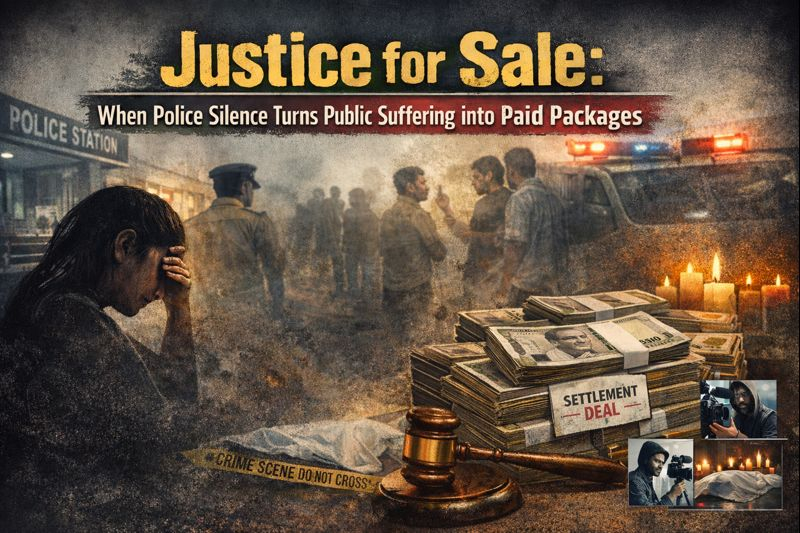
Is the police department today a symbol of confidence—or a source of fear?
This is not an emotional reaction.
This is not a personal complaint.
This is the lived reality of common people across cities and villages.
Once, entering a police station meant hope—hope for protection, justice, and resolution.
Today, for many citizens, it means hesitation, fear, and silent withdrawal.
For the police, a complaint may look like just another case—routine, repeated, paperwork.
But for the victim, it is their life, their pain, their dignity, their safety, and their survival.
There is no “small case” when someone’s peace is destroyed.
Where Is the System? Where Is Accountability?
Every complaint should have a clear process, a fixed deadline, proper follow-up, and a respectful, humane response.
But is this happening?
Ground reality says no.
Constables often do not respond properly.
If they respond, delays become normal.
Issues are pushed forward again and again.
Sub-Inspectors are rarely seen.
Instead of lawful case registration, people are pushed toward settlements, adjustments, and unofficial compromises—inside police stations and even outside.
Justice is no longer a right.
It is negotiated.
When Police Fail, an Illegal Market Thrives
Here is the most dangerous shift happening silently.
Today, problems are being solved through packages.
If 5 people are involved in a dispute, there is one package amount.
If 10 people are involved, the package increases.
If the issue must be solved quickly, the price goes higher.
If it needs pressure, influence, or silence, the amount multiplies.
From ₹5,000 to lakhs, justice is being sold based on the size of the problem and the number of people involved.
Suffering has become a business model.
The most disturbing question remains unanswered.
Why does the police remain calm and silent in areas where this package system openly operates?
From Police Stations to Middlemen
Because people have lost trust, they no longer approach police stations first.
They now approach media houses, social media influencers, self-proclaimed problem solvers, and known rowdy sheeters posing as mediators.
Many expect something in return.
Nothing moves without money, influence, or benefit.
Even Media Waits for Death
Another harsh reality must be spoken.
Even the media often needs death to respond.
Those who are alive—suffering, fighting, begging for justice—are ignored.
Pain without blood does not trend.
Struggle without a body count is not news.
Cases Increase, Responsibility Shrinks
If cases are increasing, manpower must increase.
Resources must increase.
Monitoring systems must be strengthened.
But cases should not remain pending for years.
Justice delayed is not just justice denied.
It is an open invitation for illegal settlements, packages, and exploitation.
This Is Not an Allegation—This Is a Question
This is not written to insult or defame.
It is written to question, because questioning is the duty of responsible journalism.
When people fear the police more than the problem itself, the issue is not public behavior.
The issue is institutional failure.
The police must ask themselves.
Are we protecting victims or creating space for middlemen?
Are we solving cases or allowing packages to replace justice?
Are police stations centers of law or negotiation hubs?
Until these questions are answered with action, trust will continue to collapse.
And when justice is sold in packages, society pays the price.
___Reshma Mohammed