
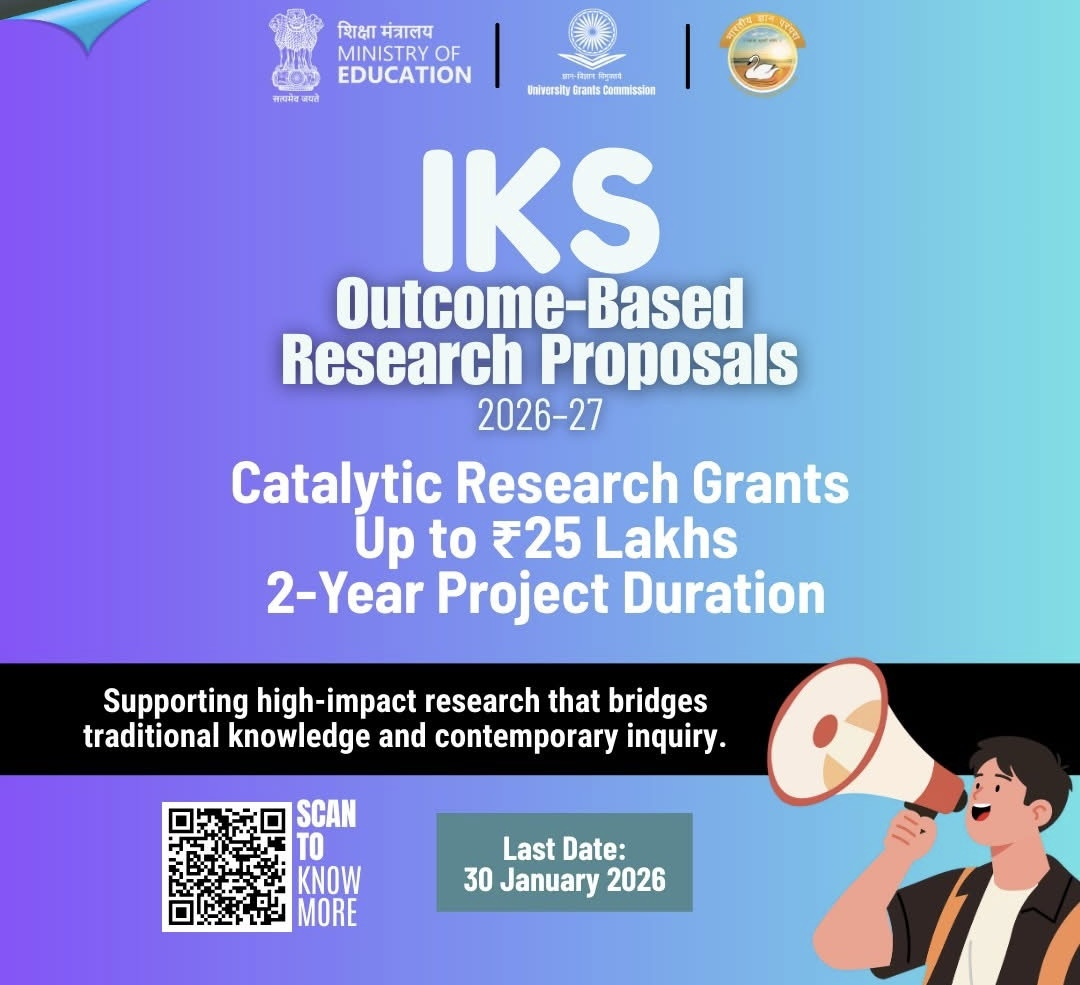
The Indian Knowledge Systems (IKS) Division, under the Ministry of Education, Government of India, has officially invited applications for the IKS Competitive Research Proposals Program 2026–27.
Below are the key details for interested researchers and institutions:
Important Dates
Last Date to Apply: 30th January 2026
Announcement of Awards: 27th February 2026
Funding Availability: 15th April 2026
Annual Progress Report Due: 29th January 2027
Final Report Deadline: 31st March 2028
💰 Funding Details
Maximum Support: Up to ₹20 Lakhs per research project.
Duration: Two years.
🏫 Eligibility Criteria
Principal Investigators (PI): Faculty members in any Government-recognized educational institution (private or public), Government-funded labs, and NGOs/Trusts/Foundations.
Experience: PIs should generally have at least 5 years of experience.
Gurukulas: Acharyas in any Gurukula or Pathashala and practicing artists with at least 5 years of experience are also eligible.
🔍 Research Priority Areas
The program focuses on 16 specific thematic areas including:
Vedic Philosophical and Cognitive Sciences
Mathematical, Physical, and Astronomical Sciences
Medical and Health Sciences (including Ayurveda/Yoga)
Agricultural Science, Veterinary & Animal Husbandry
Mechanical & Digital Design & Engineering
Fine Arts, Performing Arts, and Sculpture
Political, Economic, and Strategic Sciences
📋 Submission Requirements
Proposals must be submitted online and should follow a specific structure (usually limited to 10 pages for the narrative). Required documents typically include:
Proposal Narrative & Cover Page
Budget Details
Resumes of PI and Co-PIs
Institutional Approval & Signature Pages
Plagiarism Detection & AI-generated Content Report
🔗 Relevant Links
Application Portal: iksindia.org/research-proposal-form.php
Official Website: iksindia.org
This program aims to bridge the gap between traditional Indian knowledge and contemporary science, prioritizing research that leads to practical products, solutions to societal problems, or a deeper understanding of the “Indian way” of development.

