

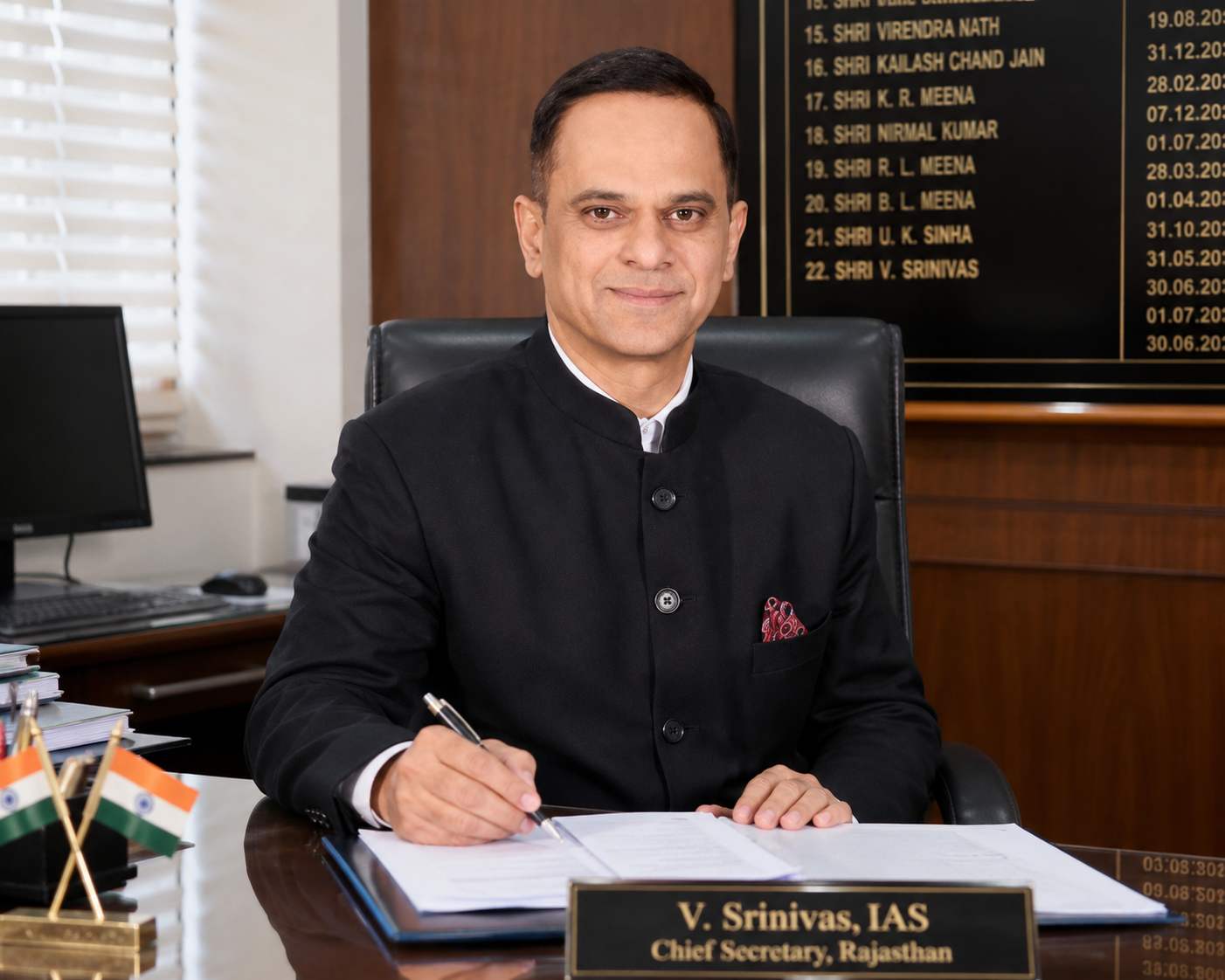
An accomplished 1989-batch Rajasthan cadre IAS officer, V. Srinivas has combined administrative excellence, governance reforms, and citizen-centric innovation to shape public administration at both the state and national levels.
Profile at a Glance
“Good governance is not merely about making policies—it is about delivering services efficiently, transparently, and with empathy.” This principle has defined the distinguished career of V. Srinivas, IAS, one of India’s most respected civil servants.
V. Srinivas (Voruganti Srinivas) is a 1989-batch Indian Administrative Service (IAS) officer of the Rajasthan Cadre, currently serving as the Chief Secretary, Government of Rajasthan. Over a career spanning more than three decades, he has served in several prestigious positions in the Government of India and the Government of Rajasthan, including Secretary, Department of Administrative Reforms & Public Grievances, Secretary, Department of Pension & Pensioners’ Welfare, Director General of the National Centre for Good Governance (NCGG), and Chairman of the Board of Revenue, Rajasthan. He is also known internationally for serving as President of the International Institute of Administrative Sciences (IIAS), Brussels.
The Catalyst – The Inspiration Behind Joining Public Service
Coming from an engineering background, V. Srinivas initially pursued a career in technology. However, his desire to contribute to nation-building and public policy inspired him to appear for the UPSC Civil Services Examination.
His academic excellence in Chemical Engineering, combined with a strong interest in governance, public finance, and institutional reforms, motivated him to choose the IAS over a conventional engineering career. Throughout his service, he has remained committed to improving governance through technology, transparency, and administrative innovation.
Early Life and the UPSC Journey
Born on 1 September 1966, V. Srinivas completed his schooling before pursuing B.Tech and M.Tech in Chemical Engineering from the College of Technology, Osmania University, graduating with distinction. After a brief stint as a Management Trainee at IPCL, Mumbai, he qualified for the UPSC Civil Services Examination and joined the Indian Administrative Service in 1989, being allotted the Rajasthan Cadre. His engineering mindset later became a strength in designing reforms, digital governance initiatives, and administrative modernization.
Education
- B.Tech in Chemical Engineering – College of Technology, Osmania University
- M.Tech in Chemical Engineering – College of Technology, Osmania University
- Specialized interests in:
- Public Finance
- Planning
- Health & Family Welfare
- Revenue Administration
Stepping into the Field – Notable Administrative Stints
District Collector
During his tenure as District Collector in Rajasthan, V. Srinivas worked extensively on rural development, public service delivery, and district administration, gaining valuable grassroots experience.
Chairman, Board of Revenue, Rajasthan
As Chairman of the Board of Revenue, he introduced administrative reforms aimed at improving land revenue administration, reducing case backlogs, and enhancing transparency in revenue courts.
Government of India
He served in several Union Ministries, including:
- Finance
- External Affairs
- Petroleum & Natural Gas
- Textiles
- Culture
- Health & Family Welfare
- Personnel, Public Grievances & Pensions
His work focused on governance reforms, digital public administration, pension reforms, and citizen-centric service delivery.
Major Achievements
1. Digital Governance Reforms
Led initiatives to digitize grievance redressal systems and strengthen online public service delivery, making governance more transparent and efficient.
2. Pension Reforms
As Secretary, Department of Pension & Pensioners’ Welfare, he spearheaded reforms to simplify pension processes and improve services for retired government employees.
3. Administrative Reforms
Played a key role in modernizing government procedures through technology-driven governance, reducing delays, and improving accountability.
4. Capacity Building
As Director General of the National Centre for Good Governance (NCGG), he promoted training and capacity-building programs for civil servants from India and several partner countries.
5. International Leadership
Elected President of the International Institute of Administrative Sciences (IIAS), Brussels, reflecting global recognition of his contributions to public administration.
The Turning Point – Championing Good Governance
One of V. Srinivas’s most significant contributions has been institutionalizing citizen-centric governance through digital platforms and administrative reforms. His work has focused on making government services more accessible, transparent, and accountable while reducing bureaucratic delays. His leadership in administrative reforms has become a benchmark for modern governance in India.
Challenges Overcome
Throughout his career, V. Srinivas has handled:
- Complex governance reforms across multiple ministries.
- Large-scale digital transformation in public administration.
- Public grievance redressal modernization.
- Pension reforms affecting millions of retirees.
- Revenue administration in Rajasthan.
- Coordination between the Union and State Governments.
His ability to build consensus and implement reforms has been a hallmark of his administrative career.
Awards & Recognition
Some of his notable recognitions include:
- President, International Institute of Administrative Sciences (IIAS), Brussels.
- Rajbhasha Kirti Puraskar (2024 and 2025).
- Digital India Award (2020).
- AIIMS Leadership Excellence Award (2017).
- Several appreciation awards and commendations from national and international institutions for excellence in governance and administrative reforms.
Leadership Philosophy
V. Srinivas strongly advocates:
- Transparent governance
- Technology-enabled administration
- Citizen-first public service
- Administrative accountability
- Continuous institutional reforms
His work consistently reflects the belief that governance must be efficient, inclusive, and responsive.
Personal Insight
A theme reflected in his public speeches and administrative work is:
“Technology, transparency, and accountability are the pillars of good governance.”
Conclusion – The Vision Ahead
As Chief Secretary of Rajasthan, V. Srinivas continues to guide the state’s administrative machinery with a focus on governance reforms, digital transformation, and sustainable development. His distinguished journey—from a chemical engineer to one of India’s foremost civil servants—illustrates how expertise, integrity, and innovation can transform public administration. His career remains an inspiration for UPSC aspirants and public administrators across the country.
Quick Reference
- Full Name: Voruganti Srinivas
- Current Posting: Chief Secretary, Government of Rajasthan
- Previous Postings:
- Secretary, Department of Administrative Reforms & Public Grievances
- Secretary, Department of Pension & Pensioners’ Welfare
- Director General, National Centre for Good Governance
- Chairman, Board of Revenue, Rajasthan
- District Collector
- Joint Secretary and Additional Secretary in various Union Ministries
- Awards & Achievements:
- President, IIAS (Brussels)
- Rajbhasha Kirti Puraskar (2024 & 2025)
- Digital India Award (2020)
- AIIMS Leadership Excellence Award (2017)
- Education:
- B.Tech (Chemical Engineering), Osmania University
- M.Tech (Chemical Engineering), Osmania University
- Batch: 1989
- Cadre: Rajasthan
- Promotions: IAS Officer → District Collector → Secretary, Government of India → Chief Secretary, Government of Rajasthan
- Key Issues Handled:
- Administrative reforms
- Digital governance
- Pension reforms
- Revenue administration
- Public grievance redressal
- Capacity building of civil servants
- Inspirations to Count:
- Excellence in governance
- Commitment to transparency
- Innovation in public administration
- International leadership in administrative sciences
Message from the Officer
“The true measure of public service lies in improving the lives of citizens through efficient, transparent, and compassionate governance. Every civil servant must strive to leave institutions stronger than they found them.”