

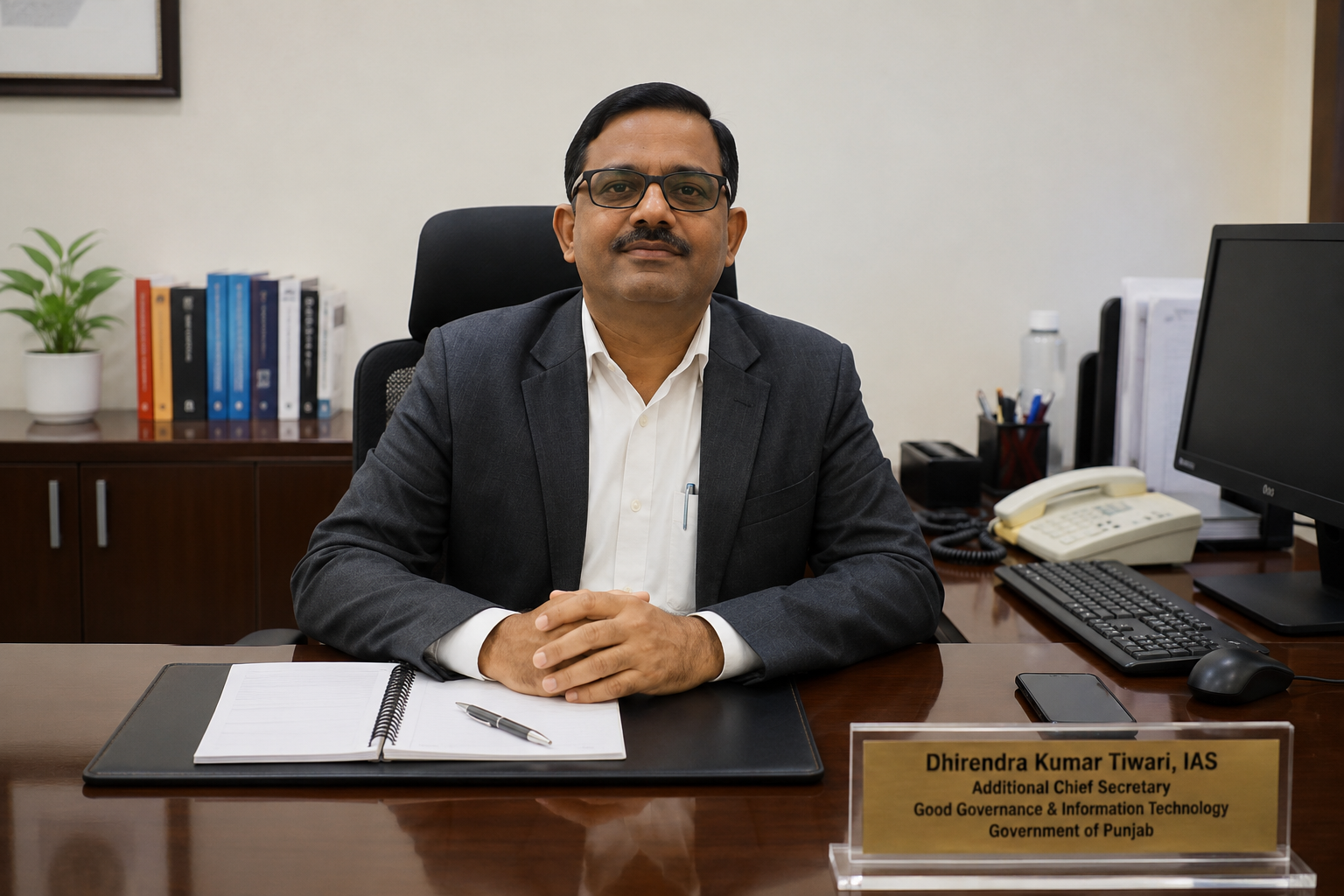
A 1994-batch Punjab-cadre IAS officer, Dhirendra Kumar Tiwari brings more than three decades of administrative experience to Punjab’s governance, technology, excise and public-service delivery landscape.
Profile at a Glance
A 1994-batch Indian Administrative Service officer of the Punjab cadre, Tiwari currently serves as Additional Chief Secretary-cum-Financial Commissioner, Excise, while also holding the responsibilities of Additional Chief Secretary, Good Governance & Information Technology and Additional Chief Secretary, Parliamentary Affairs. These responsibilities are officially listed by the Government of Punjab.
His present role in Good Governance & Information Technology is particularly significant because Punjab’s administration is increasingly focused on digital public services, technology-enabled transparency and reducing unnecessary human intervention in government processes.
At a 2025 technology-sector event, Tiwari outlined a vision of a fully digital, citizen-centric governance model for Punjab, emphasizing faster, more transparent and seamless public services and reduced human intervention as a means of curbing corruption.
The Catalyst – The Making of a Civil Servant
Therefore, it would be inappropriate to invent a personal story about his childhood ambitions or family circumstances.
What is clear is that he entered the Indian Administrative Service in 1994 and subsequently built a career across several critical areas of government.
His career demonstrates the broad responsibilities expected of a senior IAS officer: district administration, departmental management, public infrastructure, social welfare, rural development, transport, finance, technology-enabled governance and regulatory administration.
That breadth is especially important in understanding his present assignment. His current work in Good Governance & IT is not isolated from his earlier administrative experience; rather, it brings together years of exposure to the practical challenges of government delivery.
Early Life and Education
However, available service records provide important educational information.
The Punjab IAS record lists his academic qualifications as B.E./B.Tech (Civil) and M.A. (Economics).
A more recent publicly available service-profile compilation records additional higher academic qualifications, including a Ph.D.
His educational combination is notable because it brings together:
- Engineering and technical understanding
- Economic and policy analysis
- Public administration
- Higher academic research
That combination is particularly relevant to his later responsibilities involving infrastructure, public finance, governance systems and technology.
The UPSC Journey
Tiwari entered the IAS in 1994, becoming part of the Punjab cadre.
Over the years, his career evolved from field-level administration to increasingly senior policy and secretariat responsibilities.
The progression reflects one of the defining characteristics of the IAS: officers must repeatedly adapt to different sectors, geographical contexts and policy challenges.
For Tiwari, this journey has included assignments connected with:
- District administration
- Urban administration
- Rural development
- Water and sanitation
- Social justice
- Transport
- Finance and fiscal administration
- Excise administration
- Good governance
- Information technology
- Parliamentary affairs
Stepping Into the Field – From District Administration to State Leadership
Tiwari’s career has not been confined to the state secretariat.
Available service records show that he has served in positions including Deputy Commissioner, Municipal Commissioner and Additional District Magistrate & Collector, alongside senior departmental roles.
This field experience is important because modern governance requires senior policymakers to understand how policies actually function on the ground.
His subsequent career included roles such as:
- Secretary/Mission Director
- Managing Director
- Chief Executive Officer
- Principal Secretary/Financial Commissioner
- Additional Chief Secretary
- Deputy Commissioner
- Municipal Commissioner
- Additional District Magistrate & Collector
These assignments demonstrate a career that moved from frontline administration to high-level policy coordination.
The Turning Point – From Digital Services to Digital Governance
Tiwari’s current assignment gives him an opportunity to take the idea of digital government much further.
As Additional Chief Secretary, Good Governance & Information Technology, his department is responsible for a policy area at the intersection of technology, governance reform and citizen service delivery. The Punjab Government officially lists him as the department’s senior-most administrative officer.
His approach has been publicly articulated around a key idea:
Challenges Overcome
The career of a senior IAS officer is shaped by challenges that are fundamentally different from the operational risks associated with policing.
For Tiwari, documented responsibilities show experience with complex administrative situations involving:
- Public service delivery
- Rural development
- Social welfare
- Transport administration
- Financial management
- Excise regulation
- Digital governance
- Technology investment
- Inter-departmental coordination
One particularly challenging episode came in 2023 during the controversy surrounding the dissolution of Punjab’s elected rural local bodies.
Tiwari, then Principal Secretary of the Rural Development and Panchayats Department, was among two IAS officers suspended after the Punjab Government withdrew its notification dissolving gram panchayats, panchayat samitis and zila parishads.
The episode illustrates the difficult institutional environment in which senior civil servants sometimes have to make decisions involving legal, administrative and political considerations.
For a balanced article, this episode should be presented as an administrative controversy, not as a personal accusation of wrongdoing.
Major Achievements and Administrative Contributions
Rather than attributing police-style “cases solved” or anti-crime operations to an IAS officer, Tiwari’s achievements should be evaluated through the lens of governance and public administration.
1. Digital and Citizen-Centric Governance
He has publicly promoted the use of technology to make government services more transparent, seamless and citizen-focused.
2. Reducing Human Intervention
His digital-governance approach emphasizes reducing unnecessary human interaction in government processes, with the stated objective of improving accessibility and helping curb corruption.
3. Technology-Enabled Public Finance
During his Water Supply & Sanitation tenure, he was associated with efforts around mGramSeva and digital public-finance management for rural local bodies.
4. IT Industry Development
As Additional Chief Secretary for IT, he has played a public-facing role in communicating Punjab’s incentives and policy framework for IT and ITeS investment.
5. Multi-Sector Administration
His responsibilities across social justice, transport, water and sanitation, excise, parliamentary affairs and technology demonstrate considerable administrative breadth.
Awards & Recognition
However, his career includes significant professional recognition:
1. Promotion to the Apex Scale / Additional Chief Secretary
A major career milestone came when the Punjab Government promoted Tiwari, a 1994-batch IAS officer, to the Apex Scale and designated him Additional Chief Secretary. His promotion was effective from 28 January 2024.
2. Senior Leadership in Good Governance & IT
He currently serves as Additional Chief Secretary, Good Governance & Information Technology, according to the Punjab Government’s official department directory.
3. Multi-Department Administrative Responsibility
The current Punjab Government directory also lists him as Additional Chief Secretary-cum-Financial Commissioner, Excise, with additional responsibility for Good Governance & Information Technology and Parliamentary Affairs.
4. Recognition for Digital Governance Leadership
In 2026, Tiwari publicly presented Punjab’s technology-investment strategy at the Progressive Punjab Investors’ Summit, including incentives intended to develop Mohali as a major IT hub. This represents an important aspect of his current administrative leadership in technology and economic development.
Personal Insight
Technology should not merely digitize government processes; it should make government more transparent, accessible and accountable to citizens.
Awards, Legacy and Institutional Impact
Tiwari’s legacy is still evolving because he remains in active service.
At present, the strongest themes associated with his administrative career are:
Digital Transformation
Promoting technology as a tool for better government.
Citizen-Centric Administration
Focusing on making government services easier and more accessible.
Transparency
Using digital systems to reduce unnecessary human intervention.
Economic Development
Supporting Punjab’s efforts to attract IT and technology investments.
Administrative Versatility
Working across multiple complex departments during a long IAS career.
Institutional Leadership
Managing several senior-level responsibilities simultaneously.
Conclusion – The Vision Ahead
Dhirendra Kumar Tiwari’s journey represents the changing face of Indian administration.
The traditional image of the civil servant is often associated with files, offices and physical government infrastructure. But the next generation of governance is increasingly shaped by data, digital platforms, artificial intelligence, online services and technology-enabled accountability.
As Punjab’s Additional Chief Secretary for Good Governance & Information Technology, Tiwari finds himself at the centre of this transition.
His career—from field administration and water and sanitation to social justice, transport, excise and digital governance—shows the breadth required of a senior IAS officer.
The larger challenge ahead is not simply to digitize existing systems. It is to make technology genuinely useful to citizens.
If Punjab succeeds in creating government services that are faster, simpler, more transparent and less dependent on physical interaction, the impact will extend far beyond government offices.
That is the larger significance of Tiwari’s present assignment: using technology not as an end in itself, but as an instrument for better governance and stronger public trust.
Quick Reference
- Full Name: Dhirendra Kumar Tiwari, IAS
- Service: Indian Administrative Service
- Batch: 1994
- Cadre: Punjab
- Current Posting: Additional Chief Secretary-cum-Financial Commissioner, Excise
- Additional Charge: Additional Chief Secretary, Good Governance & Information Technology
- Additional Charge: Additional Chief Secretary, Parliamentary Affairs
- Date of Birth: 30 December 1968
- Domicile: Uttar Pradesh
- Original Appointment: 4 September 1994
- Education: B.E./B.Tech (Civil), M.A. (Economics); later records also list a Ph.D.
- Previous Responsibilities: Water Supply & Sanitation, Social Justice, Empowerment & Minorities, Transport and other senior administrative assignments.
- Promotion: Elevated to Additional Chief Secretary/Apex Scale, effective 28 January 2024.
- Key Issues Handled: Digital governance, public-service delivery, water and sanitation, social justice, transport administration, excise, IT investment and institutional governance.
- Key Governance Focus: Digital, transparent, seamless and citizen-centric administration.
- Technology Vision: Reduce unnecessary human intervention and improve service accessibility and transparency.
- Current Professional Focus: Good Governance, Information Technology, Excise and Parliamentary Affairs.
The Message From the Officer
Good governance must be accessible to citizens, transparent in its processes and efficient in its delivery. Technology can help government move in that direction by making services faster, simpler and less dependent on unnecessary human intervention.