

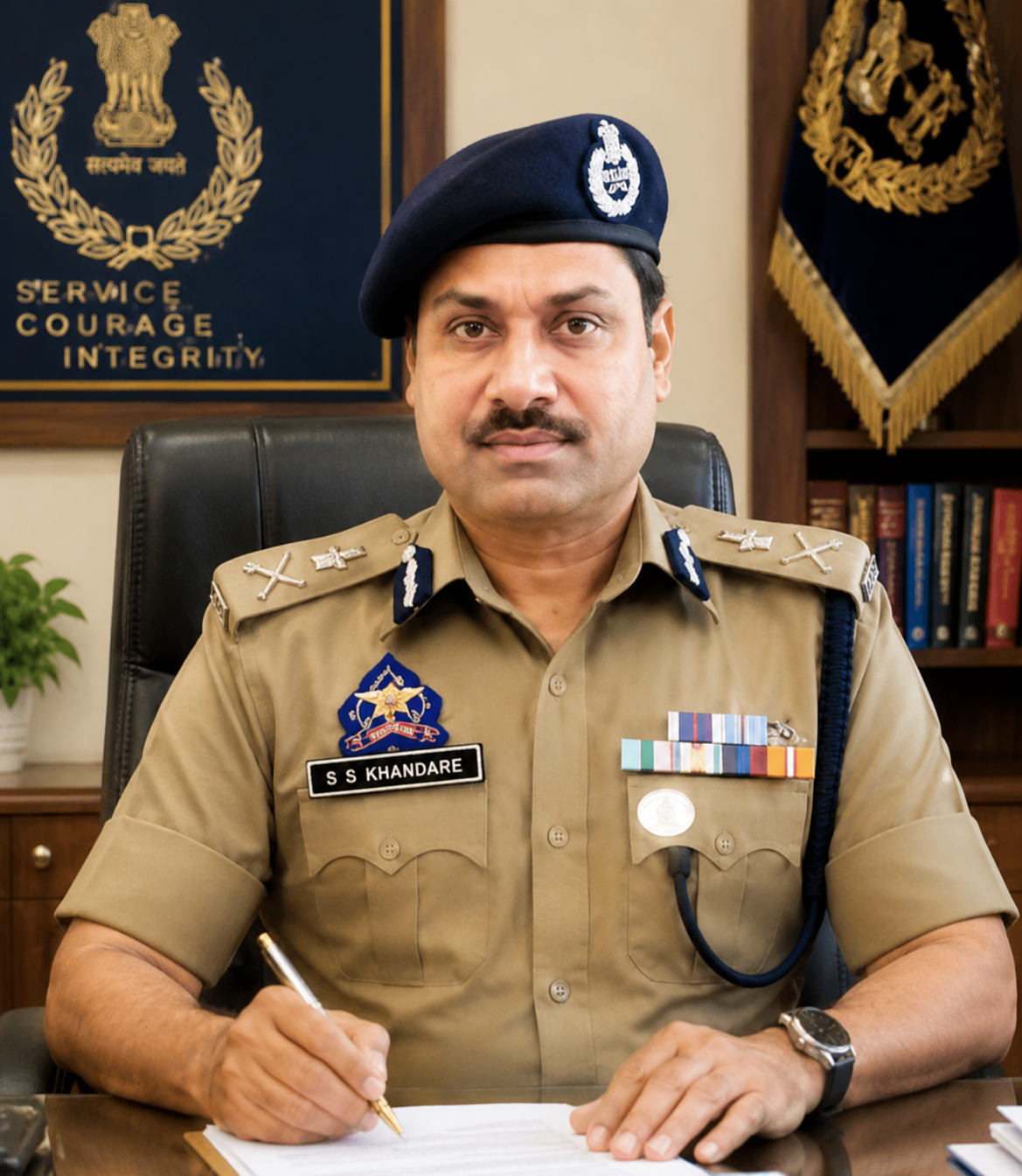
Satish Shriramaji (S.S.) Khandare, IPS, a distinguished AGMUT cadre officer, became the inaugural head of the Ladakh Police after the Union Territory was created in 2019, laying the foundation for a modern, professional, and citizen-centric police force in one of India’s most strategically important regions.
Profile at a Glance
“Building an institution is often more challenging than leading an established one.”
When the Union Territory of Ladakh was carved out in October 2019, the newly formed administration faced the monumental task of creating its own police leadership and organizational structure. At this historic moment, Satish Shriramaji Khandare (S.S. Khandare), IPS,1995batch was entrusted with one of the most significant responsibilities—becoming the first Inspector General of Police (IGP) and inaugural head of Ladakh Police.
A senior Indian Police Service (IPS) officer of the AGMUT cadre, Khandare led the establishment of the police organization from the ground up. His tenure focused on institution-building, strengthening internal security, improving coordination among security agencies, and ensuring effective policing across Ladakh’s vast and challenging terrain. His leadership laid the administrative and operational foundation on which the Ladakh Police continues to serve today.
The Catalyst – Why He Chose the Indian Police Service
Like many dedicated civil servants, S.S. Khandare chose the Indian Police Service with a vision of serving the nation through professional policing, public safety, and constitutional governance.
His career reflects a commitment to:
- National security
- Rule of law
- Ethical policing
- Public service
- Institution-building
- Leadership in difficult environments
- Strengthening police professionalism
- Citizen-centric policing
These principles became especially significant when he was entrusted with creating the policing framework for India’s newest Union Territory.
Early Life and the UPSC Journey
S.S. Khandare demonstrated discipline, determination, and leadership qualities from a young age. Motivated by a desire to contribute to nation-building, he pursued higher education and successfully cleared the highly competitive Union Public Service Commission (UPSC) Civil Services Examination, earning a place in the prestigious Indian Police Service.
He joined the AGMUT cadre, where he gained extensive experience in policing, administration, and leadership before taking on one of the most historic assignments of his career.
Stepping into the Field – Notable Stints
Before leading the Ladakh Police, S.S. Khandare served in several important policing assignments under the AGMUT cadre. His career included responsibilities in:
- District policing
- Law and order management
- Internal security
- Police administration
- Crime investigation
- Personnel management
- Strategic planning
- Security coordination
These experiences prepared him for the unprecedented challenge of leading a newly established police force.
The Turning Point – Building the Ladakh Police
The defining chapter of S.S. Khandare’s career came in 2019, when he became the first Inspector General of Police (IGP) and Head of the Ladakh Police following the formation of the Union Territory.
His responsibilities included:
- Establishing the organizational structure of Ladakh Police.
- Creating administrative systems and operational procedures.
- Coordinating with the Ministry of Home Affairs and the UT Administration.
- Developing policing strategies suited to Ladakh’s unique geography.
- Ensuring smooth law-and-order management during the administrative transition.
- Building coordination with the Indian Army, Central Armed Police Forces (CAPFs), and intelligence agencies.
- Recruiting, training, and organizing police personnel.
His leadership played a crucial role in ensuring that the newly created Union Territory had a stable, efficient, and professional policing system from its inception.
Major Achievements & Contributions
1. Establishing the Ladakh Police
One of S.S. Khandare’s most significant achievements was laying the institutional foundation of the Ladakh Police, including administrative structures, operational systems, and coordination mechanisms.
2. Maintaining Law and Order During Transition
The transition from the former State of Jammu & Kashmir to the Union Territory of Ladakh required careful planning and effective policing. Under his leadership, law and order remained stable during this historic administrative change.
3. Strategic Security Coordination
Given Ladakh’s international borders and strategic importance, he strengthened coordination among the police, armed forces, and central security agencies.
4. Community Policing
Recognizing the importance of public trust, he encouraged community engagement and worked to build confidence between the police and local residents across Ladakh.
5. Police Modernization
He promoted modern policing practices, including improved communication systems, technology-enabled policing, better infrastructure, and professional training.
Challenges Overcome
Building a New Police Organization
Creating a new police force from the ground up required exceptional administrative vision and leadership.
Policing in High-Altitude Terrain
Ladakh’s remote villages, mountainous terrain, and extreme weather posed significant operational challenges.
Strategic Border Security
Ensuring effective policing in a region bordering multiple countries required close coordination with national security agencies.
Administrative Transition
Managing policing during the transition to a new Union Territory demanded careful planning, institutional coordination, and public confidence.
Awards & Recognition
His most significant recognitions include:
- Appointment as the first Inspector General of Police and inaugural head of Ladakh Police.
- Leadership in establishing the policing framework for the newly created Union Territory.
- Contributions to police modernization and institutional development.
- Strengthening internal security and law enforcement in a strategically important region..
Personal Insight
“Strong institutions are built through integrity, professionalism, discipline, and a commitment to public service.”
Awards and Legacy
S.S. Khandare’s legacy is closely associated with the birth and institutional development of the Ladakh Police.
His contributions include:
- Founding leadership of Ladakh Police.
- Building administrative and operational systems.
- Strengthening coordination among security agencies.
- Promoting modern and professional policing.
- Encouraging community-oriented law enforcement.
His work continues to influence the functioning and growth of the Ladakh Police.
Conclusion – The Vision Ahead
S.S. Khandare’s career is a testament to visionary leadership and institution-building. As the inaugural head of the Ladakh Police, he guided the force through one of the most significant administrative transitions in recent Indian history. His dedication to professional policing, public trust, and national security has left a lasting impact on the Union Territory.
His journey reminds aspiring civil servants and police officers that true leadership is not only about managing institutions—it is about creating them and ensuring they endure.
Quick Reference
- Full Name: Satish Shriramaji (S.S.) Khandare
- Current Posting: Additional Director General (ADG), Border Security Force (BSF), Government of India (on Central Deputation)
- Historic Posting: First Inspector General of Police (IGP), Ladakh
- Previous Postings: Various policing and administrative assignments under the AGMUT cadre.
- Awards & Achievements: Inaugural Head of Ladakh Police, institution-building, police modernization, strategic security coordination.
- Education: B.E.(Civil)
- Batch:1995
- Cadre: AGMUT
- Promotions: ASP → SP → DIG → IG
- Key Issues Handled: Establishment of Ladakh Police, law and order, internal security, police modernization, border coordination, institutional reforms.
- Inspirations To Count: Integrity, discipline, leadership, institution-building, constitutional policing, public trust.
Message From the Officer
“The strength of a police organization lies not only in its resources but in its integrity, discipline, and commitment to the people it serves. Young officers should always uphold the Constitution, lead with humility, and work tirelessly to build public trust.”