

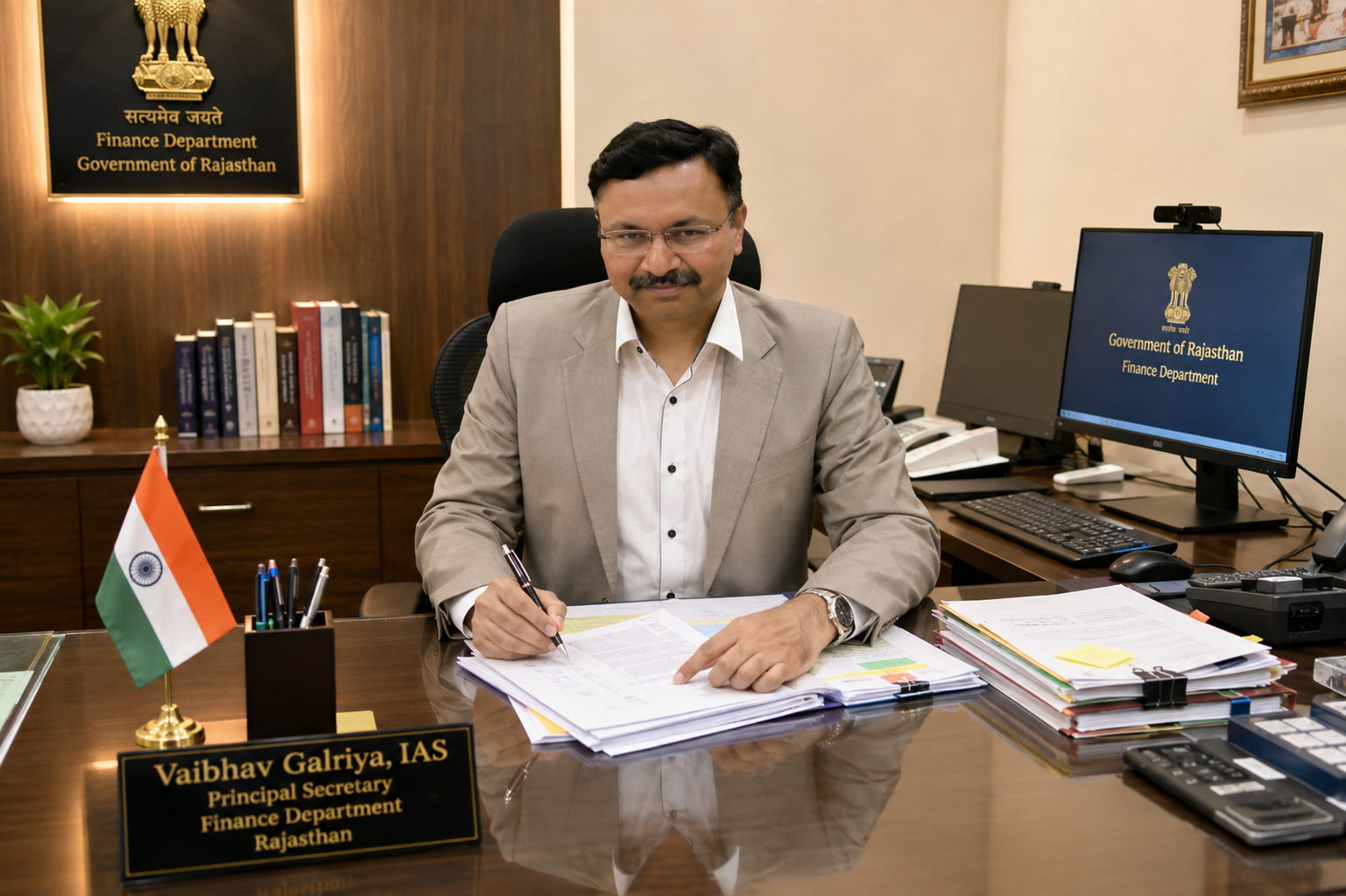
A 1998-batch Rajasthan cadre IAS officer, Vaibhav Galriya has earned a reputation as one of the state’s most capable administrators, leading major reforms across urban development, infrastructure, public works, and now steering Rajasthan’s financial governance as Principal Secretary, Finance.
Profile at a Glance
Every strong economy has a silent architect working behind the scenes. In Rajasthan, one such architect is Vaibhav Galriya, IAS, whose administrative decisions influence everything from state budgeting and infrastructure financing to public welfare expenditure.
A 1998-batch Indian Administrative Service (IAS) officer of the Rajasthan cadre, Shri Vaibhav Galriya currently serves as the Principal Secretary, Finance Department, Government of Rajasthan, one of the most influential bureaucratic positions in the state administration. He assumed this role following a major administrative reshuffle and now oversees the state’s fiscal policy, expenditure management, taxation coordination, and financial planning.
His career reflects nearly three decades of leadership in urban development, public works, higher education, agriculture, and finance—making him one of Rajasthan’s most versatile civil servants.
The Catalyst – The Inspiration Behind Joining Public Service
Although Shri Vaibhav Galriya academic background and career trajectory suggest a strong inclination toward public administration and nation-building.
Born in Rajasthan, he pursued Bachelor of Engineering (Electronics) from Malaviya National Institute of Technology (MNIT), Jaipur, followed by an M.Tech. in Management & Systems from IIT Delhi. Instead of choosing a corporate career, he entered the Indian Administrative Service, where he could contribute directly to governance, infrastructure development, and public policy.
His career reflects a consistent focus on improving governance through institutional reforms, technology adoption, and effective financial management.
Early Life and the UPSC Journey
Vaibhav Galriya hails from Bhilwara, Rajasthan. From an early age, he demonstrated strong academic ability and analytical thinking.
After completing engineering at MNIT Jaipur, he pursued higher studies at IIT Delhi, gaining expertise in technology, systems management, and policy.
Determined to serve society through public administration, he successfully cleared the Civil Services Examination and joined the IAS in 1998 as a Rajasthan cadre officer.
His technical education has played a significant role in shaping his evidence-based, systems-oriented approach to governance.
Stepping into the Field – Notable Administrative Stints
Over nearly three decades, Vaibhav Galriya has served across multiple strategic departments.
Finance Department
As Principal Secretary, Finance, he oversees:
- State Budget formulation
- Public expenditure management
- Fiscal discipline
- Taxation policy coordination
- Resource mobilisation
- Financial reforms
His office plays a central role in ensuring Rajasthan’s financial stability and long-term economic planning.
Urban Development & Housing Department
Before joining Finance, he served as Principal Secretary, Urban Development & Housing, where he supervised major urban governance initiatives, infrastructure planning, municipal reforms, and development projects across Rajasthan.
Public Works Department (PWD)
As Principal Secretary, PWD, he contributed to strengthening road infrastructure, public building projects, and transport connectivity across the state.
Jaipur Development Authority (JDA)
During his tenure as Commissioner of the Jaipur Development Authority, he was associated with urban planning, city expansion, and implementation of major infrastructure projects in Jaipur.
Higher & Technical Education
He also served in the Higher and Technical Education Department, contributing to administrative reforms and educational governance in Rajasthan.
The Turning Point – Rajasthan’s Financial Leadership
Perhaps the most significant phase of his career began when he was appointed Principal Secretary, Finance.
The Finance Department is responsible for:
- Managing thousands of crores of public expenditure
- Budget preparation
- Fiscal responsibility
- Revenue planning
- Public debt management
- Taxation oversight
- Financial approvals for major development projects
Under his leadership, the department plays a crucial role in ensuring that welfare schemes, infrastructure investments, and economic priorities are supported by sound financial planning.
Major Achievements
Throughout his career, Shri Vaibhav Galriya has been associated with several high-impact administrative responsibilities:
- Modernisation of urban governance
- Infrastructure development through PWD
- Administrative reforms in education
- Financial governance and budget management
- Public finance reforms
- Strengthening institutional coordination
- Leadership in multiple strategic departments
- Oversight of state-owned financial institutions as Chairman/Board member of several government entities.
Challenges Overcome
Handling Rajasthan’s largest departments requires balancing development priorities with limited public resources.
Some of the major administrative challenges include:
- Managing state finances amid changing economic conditions
- Balancing welfare commitments with fiscal discipline
- Coordinating large infrastructure investments
- Driving urban expansion while maintaining sustainable development
- Leading multiple high-profile departments through policy transitions
His ability to move successfully between sectors demonstrates adaptability and administrative depth.
Awards & Recognition
However, his repeated appointments to some of Rajasthan’s most important departments—including Finance, Urban Development, Public Works, Agriculture, Medical Education, and Higher Education—reflect the confidence placed in his leadership by successive state governments.
Leadership Philosophy
Throughout his career, Vaibhav Galriya has been known more for institutional leadership than public visibility.
His work demonstrates:
- Evidence-based governance
- Financial discipline
- Administrative efficiency
- Infrastructure-led development
- Long-term planning
- Technology-enabled public administration
Personal Insight
“Strong institutions, prudent financial management, and transparent governance form the foundation of sustainable development.”
Conclusion – The Vision Ahead
Few civil servants successfully lead departments as diverse as education, agriculture, public works, urban development, and finance.
Shri Vaibhav Galriya has demonstrated that effective administration is built not only on policy but also on disciplined execution and strategic vision.
Today, as Rajasthan’s Principal Secretary (Finance), he continues to shape the state’s economic future through responsible governance, fiscal prudence, and long-term planning.
His career remains an example of how professional excellence, technical expertise, and public service can together create lasting institutional impact.
Quick Reference
- Full Name: Shri Vaibhav Galriya
- Current Posting: Principal Secretary, Finance Department, Government of Rajasthan
- Previous Postings: Principal Secretary – Urban Development & Housing; Principal Secretary – Public Works; Principal Secretary – Medical Education; Principal Secretary – Agriculture, Horticulture & Panchayati Raj; Secretary – Higher & Technical Education; Commissioner – Jaipur Development Authority; Deputy Secretary – Finance.
- Awards & Achievements: Led key departments across finance, infrastructure, urban development, education, and public works; chaired/served on boards of major state financial institutions.
- Education: B.E. (Electronics), MNIT Jaipur; M.Tech. (Management & Systems), IIT Delhi.
- Batch: 1998
- Cadre: Rajasthan
- Promotions: Progressed through senior IAS leadership positions to Principal Secretary rank across multiple departments.
- Key Issues Handled: State finance, budget management, urban development, infrastructure, public works, higher education, agriculture, institutional reforms.
- Inspirations to Count: Integrity, strategic planning, fiscal responsibility, administrative excellence, technology-driven governance.
Message from the Officer
“Good governance is built through integrity, efficient institutions, prudent financial management, and unwavering commitment to public service.”